
Procognitive technology
Features of the full-spectrum procognitive LED technology
The following characteristics must be observed for full-spectrum LED luminaires to achieve the desired image forming and non-image forming biological effects without the risk of negative side effects.
Examples of suitable and unsuitable spectral compositions of a procognitive LED light (the white curve shows the spectral waveform of natural sunlight 5,000 K (CIE standard daylight illuminant D50)
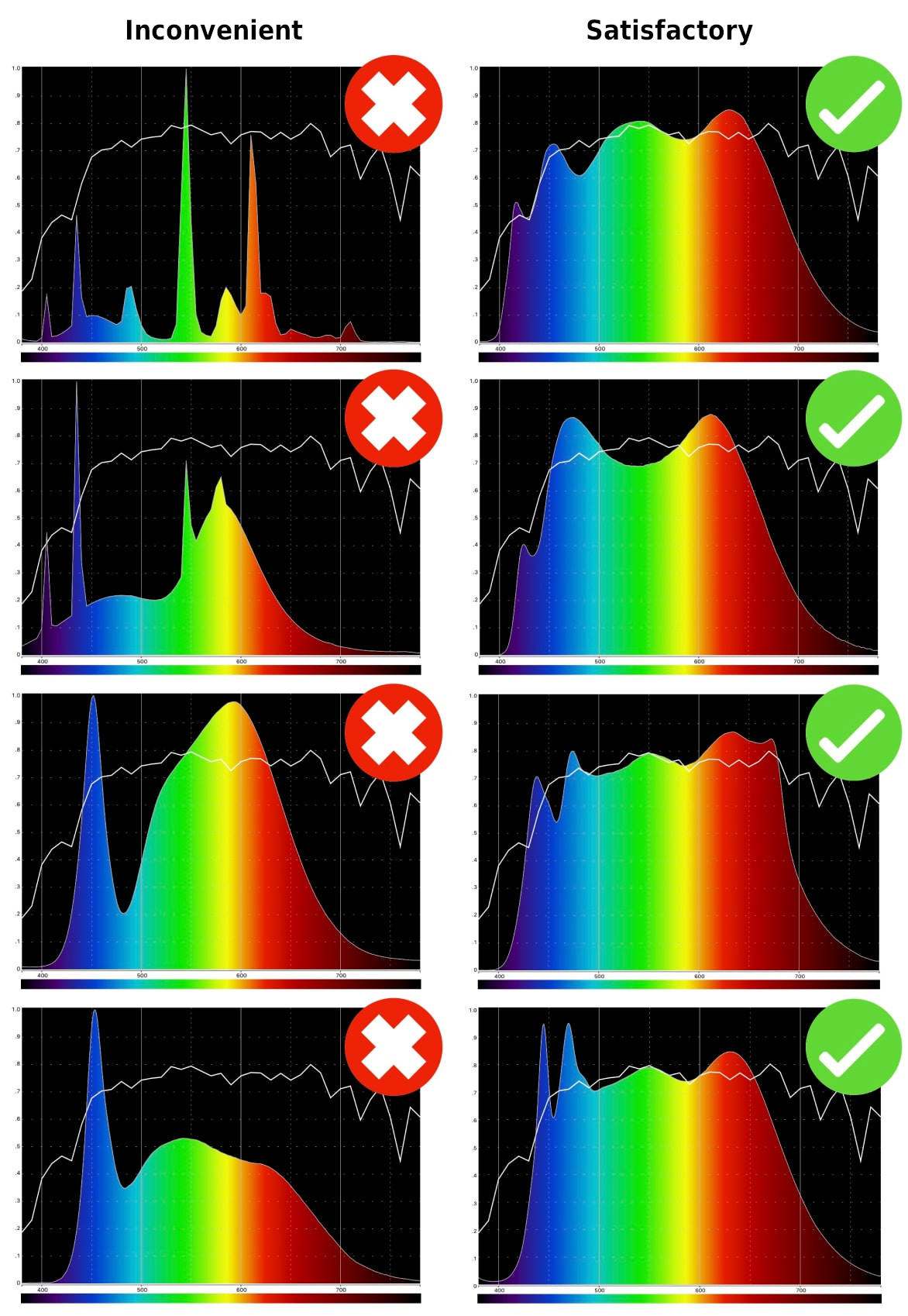
Recommended spectral and light engineering parameters of procognitive full spectrum light sources:
- Equilibrium of the spectral composition and the sun mimicking effect. In the 450-650 nm band, a balanced representation of all wavelengths is achieved with a maximum deviation of ±15% (so-called full-spectrum artificial light source)
- Balanced melanopic energy. To support circadian rhythms, the spectral composition must not show a dip in wavelengths in the 460-540 nm region (typical of conventional LEDs)
- Minimum harmful blue light. In the 415-455 nm band, a maximum of 10% of the so-called harmful blue light is emitted
- CCT corresponds to bright daylight (4,500-5,000 K)
- Colour rendering index CRI Ra greater than 91
- UGR glare factor less than 19
Other recommended parameters:
- L80B20 lifetime of at least 70,000 hours
- Energy efficiency matching the latest LED technology
- Warranty of luminaires for at least 3 years